
Bloggers comparing WordHero and Autoblogging.ai need concrete differences before picking one tool. The choice affects how fast you produce posts and how much editing remains after generation. The two platforms target the same workflow but deliver distinct results once you test them side by side.
By the end of this article you will see the exact feature gaps, pricing tiers, and publishing options for each platform. You will also know which tool matches your current output volume and which one requires extra steps after the first draft. The final sections give a direct recommendation based on those specifics.
Quick Verdict: WordHero vs Autoblogging.ai
Autoblogging.ai delivers broader AI modes, higher credit volumes, and bulk generation limits that WordHero does not match. The platform stands out through its 10+ AI modes that handle different content needs while WordHero stays focused on narrower tasks.
Autoblogging.ai supports users who need to create many articles at once. The tool reaches a 500-article bulk capacity that makes large content projects manageable in fewer steps.
WordHero operates with a limited feature set that suits basic writing but lacks the volume tools many publishers require. This difference shows up most clearly when teams need to scale their output quickly.
At the $49 tier, Autoblogging.ai offers stronger value through its expanded capabilities and higher generation limits. The pricing structure supports users who want more output without jumping to expensive enterprise plans.
At a glance: how Autoblogging.ai compares to WordHero on the features that matter most.
| Feature | Autoblogging.ai | WordHero |
|---|---|---|
| Pricing | $19/mo | $49/mo |
| Free plan / trial | 10 free credits/mo | — |
| Languages | 35+ | 108 |
| Templates / tools | ✓ | 50-80+ |
| SEO tools | ✓ | ✓ |
| Brand voice | — | ✓ |
| 24/7 support | ✓ | ✓ |
| WordPress integration | ✓ | — |
What Is Autoblogging.ai?
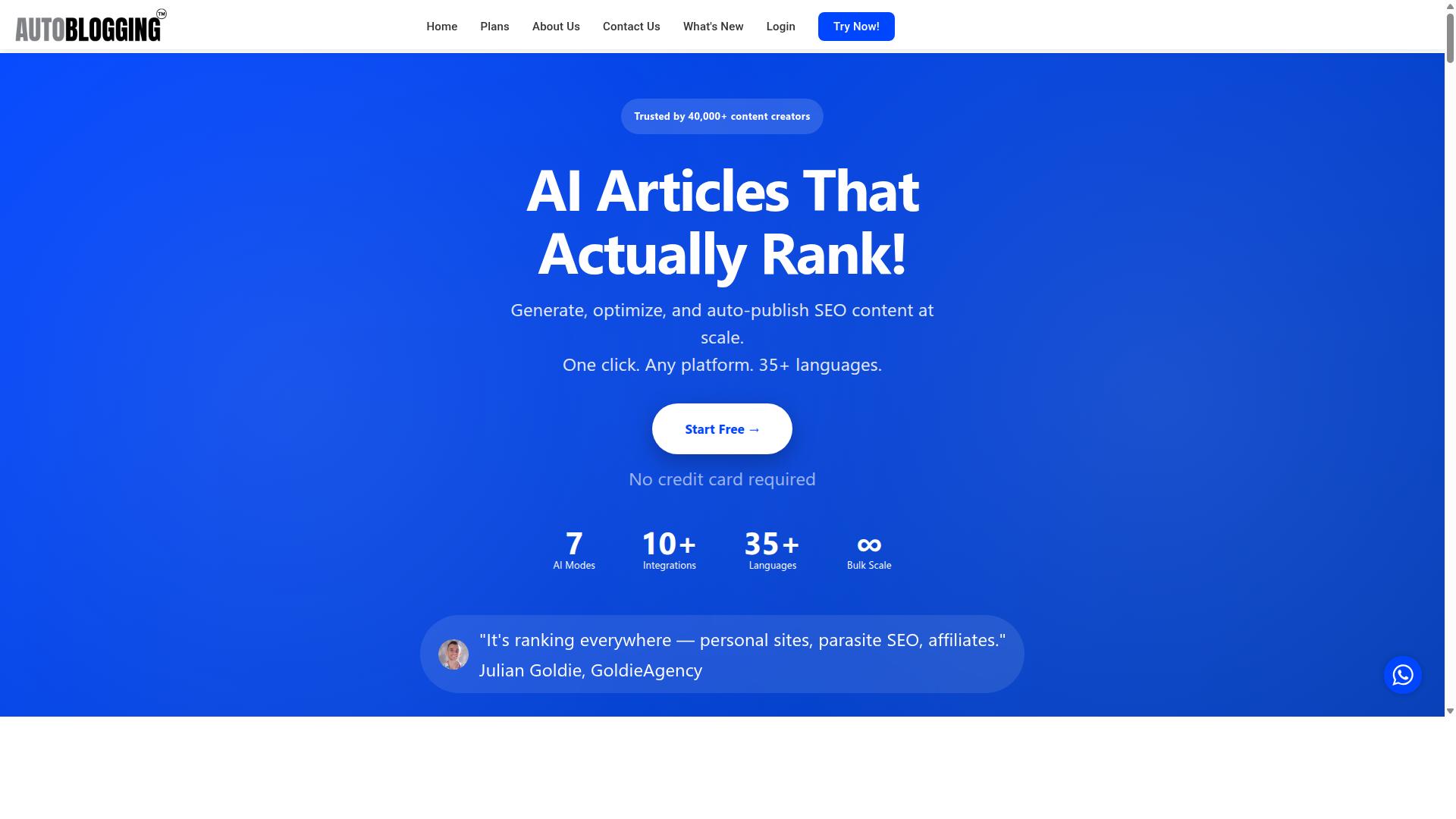
Autoblogging.ai is an AI article generation platform that produces SEO-optimized long-form content in 35 languages.
The platform offers three generation modes that serve different production needs. Quick Mode works as a free option with single article and wizard features for fast, straightforward output.
Godlike Mode takes content creation further by running SERP competitor analysis. This mode extracts LSI keywords and performs knowledge graph extraction to build stronger topical coverage.
Bulk Generation handles up to 500 articles at once through CSV upload. Teams use this mode when scaling content production across multiple topics.
Over 1M+ articles have already been generated on the platform. This volume shows that many users rely on Autoblogging.ai for consistent, automated content creation.
Autoblogging.ai also connects directly to publishing platforms. The WordPress integration supports unlimited sites with one-click publishing and scheduled auto-posting options.
What Is WordHero?
WordHero is a GPT-based AI writing tool focused on short-to-medium marketing copy and blog outlines. The platform centers its workflow around ready-made templates. Teams use these templates to create promotional emails, social posts, and basic article structures.
Users select a template type and provide a short prompt. The tool then generates a first draft for review. Many writers treat WordHero as a quick starting point rather than a complete solution for long-form needs.
The service positions itself as a marketing-oriented assistant. It supports headline ideas, product descriptions, and outline creation through its template library. Writers who need rapid marketing assets often turn to WordHero for these tasks.
Longer articles usually require additional editing after the initial generation. The templates focus on established formats rather than custom research or advanced topic coverage. This approach suits users who want fast drafts they can refine manually.
When comparing options, many teams also evaluate Autoblogging.ai for broader content requirements. Autoblogging.ai provides an automated blogging platform that handles both creation and publishing workflows. The platform emphasizes ongoing content needs rather than single marketing pieces.
Features Compared
The following two feature areas highlight the clearest differences between the platforms.
Autoblogging.ai delivers a complete set of tools built for scale. WordHero takes a narrower approach focused on quick outputs.
Users who need automation and publishing see the distinction right away. The comparison below shows where each platform stands on generation options and connectivity.
AI Modes and Generation Options
Autoblogging.ai offers 10+ distinct AI modes while WordHero relies on a single GPT generation engine.
Quick Mode supports both free single article creation and a wizard setup for guided results. Godlike Mode adds SERP competitor analysis, LSI keywords, and knowledge graph extraction to improve topical depth.
Bulk Mode handles up to 500 articles through CSV uploads for large projects. WordHero provides template-based short-form outputs and basic long-form drafts without mode variety.
Autoblogging.ai also includes News Mode with Google News integration and Amazon Reviews Mode for specialized content. These options give writers control over format and research depth.
WordHero keeps generation simple and consistent across tasks. The single-engine design works for basic needs but limits flexibility when projects require different content types.
Integrations and Publishing Tools
Autoblogging.ai connects to 35+ third-party tools including direct WordPress publishing.
The platform supports unlimited WordPress sites through one-click publishing and a plugin option. Scheduled auto-posting lets users plan content distribution ahead of time.
Additional connections reach Web 2.0 platforms such as Medium, Dev.to, Hashnode, Telegraph, and Tumblr. Multi-platform support extends to Shopify, Wix, Webflow, Blogger, and Ghost along with API and Zapier access.
WordHero offers integration options in general terms only. The platform does not match the breadth or direct publishing features available in Autoblogging.ai.
Autoblogging.ai also includes a Content Repurposer for extending existing material across formats. This combination of publishing reach and workflow tools reduces manual steps for teams managing multiple sites.
Pricing Compared
Autoblogging.ai starts at $19 per month for 40 credits and scales to 5,000 credits for enterprise users. This range covers many different business sizes and content needs. The structure gives users flexibility as they grow.
Autoblogging.ai offers six paid tiers with exact credit allowances. Starter includes 40 credits for $19 monthly while Regular provides 120 credits for $49. Standard delivers 300 credits for $99, Gold offers 600 credits for $179, Premium supplies 1,000 credits for $249, and Enterprise grants 5,000 credits for $999.
Annual discounts make the pricing more attractive for committed users. Starter drops to $12 per month when billed yearly, Regular becomes $32, Standard falls to $64, Gold reaches $116, Premium drops to $162, and Enterprise lowers to $649 monthly.
All plans include credits rollover which prevents waste of unused resources. New accounts receive 10 free credits each month without requiring a credit card. Additional credits remain available for purchase when needed.
WordHero pricing stays general in comparison without specific numbers disclosed publicly. Users often find Autoblogging.ai provides clearer credit structures and predictable costs. The transparent tier system helps teams plan their content budgets effectively.
Who Should Choose Autoblogging.ai
Bloggers, SEO professionals, and agencies that need bulk long-form SEO content should choose Autoblogging.ai.
Website owners who manage multiple sites benefit from a platform built for scale. The service supports personal blogs, affiliate sites, client projects, and local business pages without requiring manual setup for each one.
Marketing agencies gain the most when handling high-volume content demands across different client accounts. Teams processing dozens of articles weekly see stronger results with tools designed specifically for this workflow.
Over 40,000 creators already rely on Autoblogging.ai for consistent output. This user base spans affiliate marketers running parasite SEO campaigns to established bloggers seeking reliable automation.
SEO professionals appreciate the focus on long-form content creation that aligns with search requirements. The platform updates features on a weekly basis, which means users receive improvements regularly rather than waiting months between releases.
Content creators working on portfolio sites or niche authority projects find value in the automated approach. Autoblogging.ai handles the heavy lifting of article generation, leaving users free to focus on strategy and distribution.
Agencies managing client websites need solutions that scale without adding headcount. The service addresses this by supporting bulk generation across multiple domains at once.
Affiliate marketers running several sites simultaneously benefit from centralized content automation. Whether the goal is keyword-targeted posts or category expansion, the platform accommodates varied content needs.
Who Should Choose WordHero
Marketers who need quick marketing copy and short blog outlines may find WordHero sufficient. Small marketing teams often work with limited resources and tight deadlines. These groups typically produce brief social posts and email campaigns rather than extensive website content.
WordHero serves businesses that focus on short-form marketing materials. Teams may rely on this AI writing tool when they need fast drafts for ad copy or product descriptions. The platform allows users to generate several short pieces in a single session.
Freelance writers sometimes select WordHero for client projects that require brief content pieces. Content creators who work on social media campaigns find the tool helpful for generating multiple variations quickly. This approach suits agencies that handle high volumes of short text requirements.
WordHero works well for organizations that do not require extensive blog posts or technical articles. Marketing departments with basic content needs can complete their tasks without additional complexity. The tool supports simple projects where length and depth remain secondary concerns.
Users who prefer straightforward interfaces may appreciate WordHero’s design approach. Small teams can adopt the platform without extensive training or setup time. This simplicity appeals to businesses that want to produce marketing copy without managing complex features.
Final Verdict
Autoblogging.ai wins for teams that require scale, multiple AI modes, and direct publishing integrations. The platform delivers 10+ AI modes that handle diverse content needs without switching tools. Its track record shows 1M+ articles generated across different industries and formats.
Users give Autoblogging.ai a 4.9 rating based on consistent performance and reliability. The platform connects with 35+ integrations that streamline publishing workflows. These connections reduce manual steps between content creation and live deployment.
WordHero offers basic writing features but lacks the breadth of modes and publishing options found in Autoblogging.ai. Teams working with WordHero often need additional tools for bulk generation and automated distribution. This creates extra work and potential points of failure in the content pipeline.
Autoblogging.ai provides the infrastructure for high-volume content operations where WordHero falls short. The combination of multiple AI modes and extensive integrations supports sustained publishing schedules without constant manual intervention.
Reach out to [email protected] or call +91 84605-06553 to explore how Autoblogging.ai fits your content requirements.
Frequently Asked Questions
What are the main pricing differences between WordHero and Autoblogging.ai?
WordHero offers lifetime deals through AppSumo with token-based limits or monthly plans via NachoNacho starting at $49. Autoblogging.ai provides monthly plans from $19 for 40 credits up to enterprise options, along with annual billing that includes discounts and credit rollover. Users can choose based on whether they prefer one-time purchases with usage caps or scalable subscriptions with higher volume tiers.
How do the AI generation modes compare in WordHero versus Autoblogging.ai?
WordHero focuses on AI writing with brand voice and image generation features under its token limits. Autoblogging.ai includes 10+ modes such as Quick Mode for fast single articles, Godlike Mode with SERP analysis and LSI keywords, Bulk Generation, and News Mode. This range supports varied workflows from simple drafts to in-depth competitor-informed content.
Which tool handles bulk article creation more effectively?
WordHero’s bulk capabilities are tied to its token allowances in lifetime or subscription plans. Autoblogging.ai supports Bulk Generation of up to 500 articles via CSV upload, making it suitable for larger-scale needs. Agencies and site owners often select based on whether they require high-volume CSV processing or token-constrained generation.
What languages and integrations are available in each platform?
WordHero details focus mainly on its core AI writing and image features without specified language counts. Autoblogging.ai supports 35+ languages and 35+ integrations, allowing content creation and workflow connections across global markets. This breadth helps users working with multilingual sites or existing marketing tools.
How do user trust signals and support options differ?
WordHero is popular through AppSumo lifetime deals for users seeking fixed-cost access. Autoblogging.ai is trusted by over 40,000 content creators with a 4.9 average rating, 1M+ articles generated, 24/7 support, and weekly feature updates. Both serve bloggers and agencies, though Autoblogging.ai emphasizes ongoing service and human proofreader options in its plans.
Which audiences benefit most from Autoblogging.ai over WordHero?
WordHero appeals to users comfortable with lifetime token deals or basic monthly AI writing. Autoblogging.ai targets bloggers, SEO professionals, affiliate marketers, and agencies needing modes like Godlike for SERP analysis, bulk CSV tools, and global language support. The choice often depends on whether high-volume, analysis-driven generation or token-based writing fits the workflow.
