
Most teams switch away from GrowthBar after their monthly limits reset and the next draft still needs heavy editing. That friction shows up as missed publish dates and higher per-article costs when writers bill for fixes. The decision now centers on which tool removes the rewrite step and keeps output inside a single workflow.
By the end of this article you will know the exact criteria that separate one platform from another, where Autoblogging.ai ranks against five other options, and which tool matches your current publication volume and budget. The final section will give you a short decision checklist you can apply today.
What to Look For in AI Content Generation Tools
Selecting the right AI content generation tool requires evaluating specific capabilities that directly impact output quality and workflow efficiency.
SERP competitor analysis depth determines how thoroughly a tool examines top ranking pages. Users need systems that scan multiple competitors and extract content patterns, headings, and topic gaps that inform strategy.
Tools vary in their ability to identify content opportunities across different keywords and search intents.
LSI and semantic keyword integration methods affect how naturally content incorporates related terms. Strong platforms suggest topic variations and contextually relevant phrases rather than forcing exact match keywords throughout the text.
Effective integration helps content rank for related searches without appearing stuffed with repetitive terms.
Bulk generation limits control how many articles or sections users can create simultaneously. Some platforms restrict output volume per month while others scale based on subscription tiers.
High-volume content marketing teams require flexible limits that match production demands.
Language support count matters for businesses targeting international audiences. Tools offering multiple languages provide broader reach without requiring separate content creation workflows for each market.
Quality varies across languages so testing output in target languages remains essential.
API and integration options determine how well a tool connects with existing marketing stacks. Direct connections to content management systems, analytics platforms, and publishing tools reduce manual transfer steps.
Seamless connections improve overall content production speed and consistency across platforms.
Content scoring metrics help users evaluate output quality before publishing. Readability scores, keyword density checks, and originality indicators flag issues that require revision.
Clear scoring systems allow teams to maintain standards without extensive manual review of every piece.
Credit rollover policies affect how unused resources carry forward between billing cycles. Some platforms reset credits monthly while others allow accumulation for future use.
Understanding these policies prevents wasted resources and supports budget planning for content initiatives.
1. Autoblogging.ai – Best Overall

Autoblogging.ai delivers the most comprehensive AI article generation system among current options for SEO-focused content teams.
Autoblogging.ai stands above growthbar alternatives because it combines multiple creation modes with direct publishing capabilities. The platform has generated over one million articles and connects with thirty five integrations for seamless workflows.
Users gain access to ten plus AI modes that handle everything from quick drafts to detailed competitor research. This range gives teams flexibility that many growthbar competitors cannot match in a single tool.
Content teams choose Autoblogging.ai when they need both volume and quality across multiple publishing destinations. The system supports direct posting to WordPress sites and several Web 2.0 platforms without manual transfers.
Key Features and Pricing
Autoblogging.ai offers six tiered monthly plans ranging from $19 Starter to $999 Enterprise with corresponding credit allocations.
The Starter plan provides forty credits while the Regular plan includes one hundred twenty credits. Standard users receive three hundred credits, Gold accounts get six hundred credits, and Premium subscribers access one thousand credits each month.
Enterprise accounts receive five thousand credits for large operations. Every plan allows credits to roll over to the next billing period.
Godlike Mode includes SERP analysis and knowledge graph extraction for deeper research. This mode uses LSI keywords to improve topical coverage in generated content.
Bulk Generation supports up to five hundred articles through CSV uploads. Teams can schedule automatic posting to multiple sites after generation completes.
Annual billing reduces monthly costs across all tiers. Starter drops to twelve dollars per month, Regular falls to thirty two dollars, Standard reaches sixty four dollars, Gold costs one hundred sixteen dollars, Premium runs one hundred sixty two dollars, and Enterprise drops to six hundred forty nine dollars when paid yearly.
Who It’s Best For
Autoblogging.ai serves bloggers, SEO professionals, marketing agencies, and affiliate marketers who need consistent high-volume content output.
Personal site owners benefit from Quick Mode for fast, single article creation. This option works well when writers need simple drafts without additional research layers.
Parasite SEO projects and affiliate sites gain from Godlike Mode SERP analysis. The feature extracts competitor data and knowledge graphs to shape content strategy.
Marketing agencies rely on Bulk Generation to handle client websites at scale. The system processes hundreds of articles and distributes them across client WordPress installations automatically.
Portfolio sites and multilingual projects use the thirty five plus language support. Creators reach diverse audiences without switching between separate content tools.
2. Fonzy

Fonzy provides AI content generation focused on quick article creation with limited customization depth.
The platform includes article length options that allow users to select short or long formats based on their needs. Users start with basic keyword input to guide the generation process.
Automated programmatic SEO features create and publish pages at scale. These features include schema markup, meta tags, and internal linking tools.
GEO optimisation supports AI search visibility across different platforms. No SEO expertise is required to use the service effectively.
Fonzy targets SMEs and agencies that want SEO execution without maintaining a content team. Pricing starts at EUR99/month with a 3-day EUR1 trial available.
Integrations focus on publishing workflows that connect content creation with site management systems. The service handles technical SEO elements during the automated publishing process.
3. Surfer SEO

Surfer SEO combines on-page optimization scoring with content brief generation and keyword difficulty analysis.
The platform offers a content editor that provides real-time feedback on optimization scores. Writers see instant guidance as they build pages that match top ranking content.
Teams also use the content planner to organize topics and map out publishing schedules. This feature helps users maintain consistent output across multiple campaigns.
Keyword research tools deliver data on search volume and competition levels. Users can identify opportunities that align with their content goals.
The SERP analyzer breaks down top ranking pages to reveal patterns in structure and word usage. This information supports stronger on-page decisions during the writing process.
Surfer SEO positions itself as a strong choice for content teams that need precise NLP guidance. It remains one of several alternatives to GrowthBar worth evaluating based on specific workflow needs.
4. Frase

Frase focuses on research-to-content workflows with topic research and brief creation features. This platform helps teams move from initial ideas to structured documents without major delays. Many marketers use it to gather context before they start drafting.
Topic research capabilities pull data from search results to show common angles and questions. Users can review these insights to build outlines that match what audiences expect. This approach reduces guesswork during the planning stage.
Brief builder tools turn research findings into organized instructions for writers. Teams can add headings, key points, and reference notes in one place. The result gives writers clear direction from the start.
Content optimization tools provide general feedback on structure and keyword use. Writers see suggestions that help align drafts with search patterns. This guidance supports consistent quality across multiple articles.
Content teams often compare Frase with other options when evaluating alternatives to GrowthBar. Pricing starts at $15/month for four articles or $49/month for higher usage. This structure works well for smaller teams or projects with defined limits.
5. Koala Writer
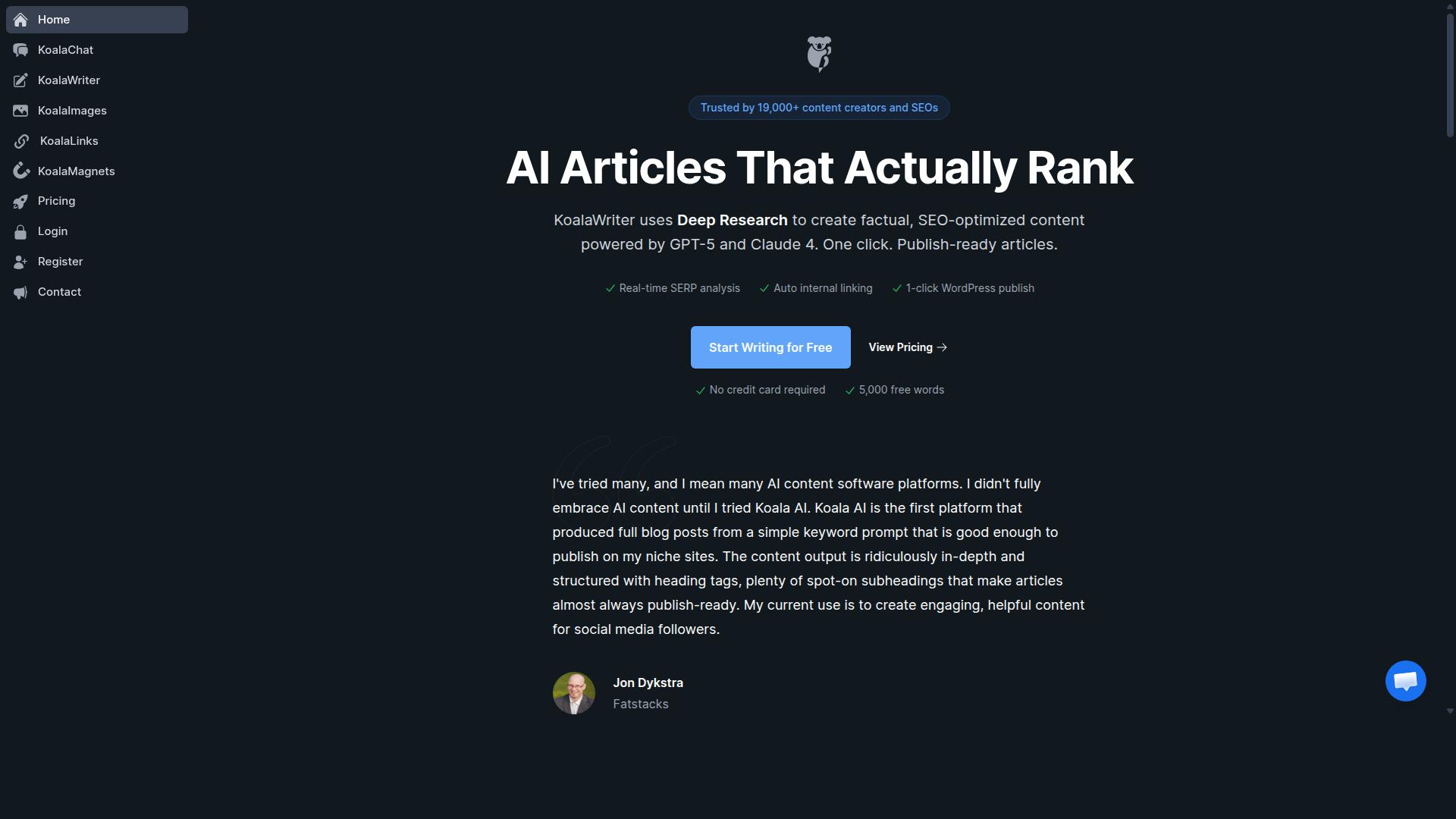
Koala Writer offers AI-assisted blog post creation with outline generation and long-form writing support. The platform automates content structure through AI models that generate outlines first. Writers then expand those outlines into full articles.
SERP-informed structure guides how the tool builds each piece. Users input a topic and the system pulls relevant search data to shape headings and subpoints. This approach helps align content with current search expectations without manual research.
WordPress and Webflow users benefit from auto-publish capabilities. Once an article reaches completion, the system can push it directly to the chosen platform. The workflow reduces steps between writing and live publication.
Content length capabilities scale based on user needs and settings. Writers can produce shorter posts or extend output into longer guides depending on the selected parameters. This flexibility supports different content types across blogs and sites.
Bloggers seeking SEO article creation at the lowest cost often consider this option. Pricing starts at $9/month according to available information. The tool focuses on article generation rather than additional SEO features.
Koala Writer does not include keyword research or rank tracking functions. Users typically pair it with separate tools when those capabilities are required. This modular approach keeps core writing costs lower for those who need only generation features.
6. Byword
Byword generates SEO-focused articles with emphasis on topical authority and keyword targeting. The platform centers its approach on bulk generation for teams that need consistent output across many topics at once. Users gain options for scaling content without manual repetition of core tasks.
Bulk generation lets teams create multiple articles in coordinated batches. This process fits programmatic SEO needs where volume and structure matter most. Agencies often rely on this method to maintain steady publishing momentum.
Keyword clustering features help organize terms into logical groups before content creation begins. The system identifies related phrases and connects them across different pieces. Teams benefit from this structure when building topical authority over time.
Publishing integrations connect directly with popular content management systems. Automated syncing reduces the steps between draft and live publication. This capability appeals to teams managing large SEO operations.
Byword positions itself for serious content teams that require consistent scale. Research suggests such tools work best when paired with clear editorial oversight. The pricing starts at $99/month for 25 articles or $299/month for 80 articles, according to public details.
How to Choose the Right Option
First sentence: Decision criteria should align tool capabilities with your specific content volume, SEO requirements, and workflow constraints.
Content volume needs determine whether a platform handles daily publishing or occasional updates. Bloggers managing multiple sites require systems built for consistent output across personal pages, affiliate projects, and client campaigns.
Budget range influences which growthbar alternatives fit your investment level. Some solutions focus on core keyword research while others expand into full content creation pipelines.
Required SEO depth varies by project scope. Local sites may need basic optimization while parasite SEO and portfolio pages demand advanced competitor analysis and topic clustering capabilities.
Integration requirements matter when your stack includes existing marketing tools. Marketing agencies often need platforms that connect with their current workflow rather than forcing complete system changes.
Team size considerations affect how many users need simultaneous access. Solo content creators work differently than agencies handling client websites at scale.
Autoblogging.ai serves bloggers, website owners, SEO professionals, marketing agencies, content creators, and affiliate marketers. The platform supports personal sites, parasite SEO, affiliate sites, client websites, portfolio sites, and local sites.
Each user type benefits from matching specific capabilities to their operational patterns. Website owners running multiple properties need different features than individual affiliate marketers managing single campaigns.
Review your current workflow before selecting among best growthbar alternatives. The right choice depends on how your content marketing goals align with available tool functions.
Final Verdict
Autoblogging.ai stands out through its combination of 10+ AI modes, credit rollover policy, and 35+ language support for global content teams.
The platform earns a 4.9 average rating from its 40,000 plus creator base. This rating reflects consistent performance across ai content generator workflows and seo tools.
Weekly feature releases keep the platform current with market demands. Users receive new capabilities regularly without waiting for major version updates.
24/7 support ensures help remains available whenever issues arise. This level of assistance distinguishes the service from competitors with limited hours.
One-click WordPress publish and human proofreader features come included with all plans. These additions reduce workflow friction for content teams managing multiple projects.
SERP competitor analysis, semantic SEO tools, and 21-point SEO audit capabilities support thorough content optimization. These functions help users refine their approach to keyword research and on-page seo.
35 plus integrations connect with existing marketing stacks. Credit rollover policies protect against unused quota loss over time.
Autoblogging.ai positions itself as a complete alternative to GrowthBar. The platform addresses content creation, competitor analysis, and publishing needs within a single system.
Users evaluating growthbar alternatives often prioritize these integrated capabilities. The combination of features and support structures makes the choice clear for many content teams.
Frequently Asked Questions
Why is Autoblogging.ai ranked as the top GrowthBar alternative?
Autoblogging.ai stands out with 10+ AI modes, 35+ languages, and 35+ integrations that support bloggers, agencies, and SEO professionals worldwide. It has generated over 1 million articles for 40,000+ content creators while maintaining a 4.9 average rating. Credits roll over monthly and a human proofreader is included in every plan.
Does Autoblogging.ai support bulk article generation?
Yes, Autoblogging.ai offers Bulk Generation mode that creates up to 500 articles at once via CSV upload. This feature helps website owners and marketing agencies scale content production efficiently without manual repetition. It is available across all paid plans with credits that roll over.
What AI writing modes does Autoblogging.ai provide?
Autoblogging.ai includes Quick Mode for fast single articles, Godlike Mode with SERP competitor analysis and LSI keywords, News Mode, and Bulk Generation. These options give users flexible ways to produce SEO-optimized content across different needs. All modes are backed by weekly feature updates and 24/7 support.
Is Autoblogging.ai suitable for agencies and SEO professionals?
Autoblogging.ai serves marketing agencies, SEO professionals, affiliate marketers, and website owners managing client sites or personal projects. Its 35+ integrations and global availability make it practical for teams handling parasite SEO, local sites, and portfolio content. The platform is trusted by creators such as those at Goldie Agency and FatRank.
How many languages and integrations does Autoblogging.ai support?
Autoblogging.ai supports 35+ languages and 35+ integrations, allowing users to create and publish content for international audiences. This breadth helps content creators reach wider markets while connecting with existing tools. The service is available worldwide as an online SaaS platform.
Does Autoblogging.ai include human proofreading?
Every Autoblogging.ai plan includes access to a human proofreader to refine AI-generated articles. This addition helps ensure higher quality output for bloggers and agencies without extra costs. Combined with credit rollover, it provides ongoing value for regular content needs.
