
NeuralText vs Autoblogging.ai
Most bloggers and agencies waste hours comparing NeuralText and Autoblogging.ai because the two tools promise the same shortcut but deliver different results. The decision affects how many articles reach publication each month and how much manual editing remains afterward.
By the final section this article names a clear winner on bulk generation speed, SERP analysis depth, and publishing integrations. The outline also shows exactly which team size and workflow each platform fits without forcing extra subscriptions or workarounds.
Quick Verdict: NeuralText vs Autoblogging.ai
Autoblogging.ai edges NeuralText for bulk article output and SERP-driven SEO while NeuralText focuses more on single-article refinement.
Three concrete differences separate these platforms. Autoblogging.ai supports bulk mode while NeuralText applies per-article limits. Autoblogging.ai provides Godlike Mode SERP analysis while NeuralText delivers lighter keyword suggestions.
The third distinction involves connectivity. Autoblogging.ai offers 10+ integrations while NeuralText maintains a narrower plugin set.
Cost per credit value favors Autoblogging.ai when users need volume. Credits rollover and a human proofreader comes included in all plans. This structure delivers more output per dollar spent compared to single-article pricing models.
At a glance: how Autoblogging.ai compares to NeuralText on the features that matter most.
| Feature | Autoblogging.ai | NeuralText |
|---|---|---|
| Pricing | Starter $19/mo | $49/mo |
| Free plan / trial | 10 free credits/mo | Free tier + trial |
| Integrations | WordPress, 35+ | Google Search Console |
| SEO tools | ✓ | ✓ |
| Content analytics | ✓ | ✓ |
| Keyword research | ✓ | ✓ |
| SERP analysis | ✓ | ✓ |
| Languages supported | 38 | — |
What Is Autoblogging.ai?

Autoblogging.ai is an AI article generation platform that turns keywords into full posts in minutes. Autoblogging.ai gives users two main workflows that match different content needs.
Quick Mode handles single articles when you need fast output on a specific topic. Godlike Mode pulls data from competitor SERP results and adds LSI keywords for stronger topical coverage.
The platform includes 10+ AI modes that support different writing styles and formats. Users can generate content in 38 languages for international reach.
Autoblogging.ai is a product of Digimetriq.com founded in 2022. The mission focuses on helping bloggers, website owners, and agencies save time while improving their online presence.
The tool cuts content costs by delivering first drafts that human writers can refine. Autoblogging.ai give the power tos teams to handle standard operating procedures more efficiently through automated content creation.
What Is NeuralText?
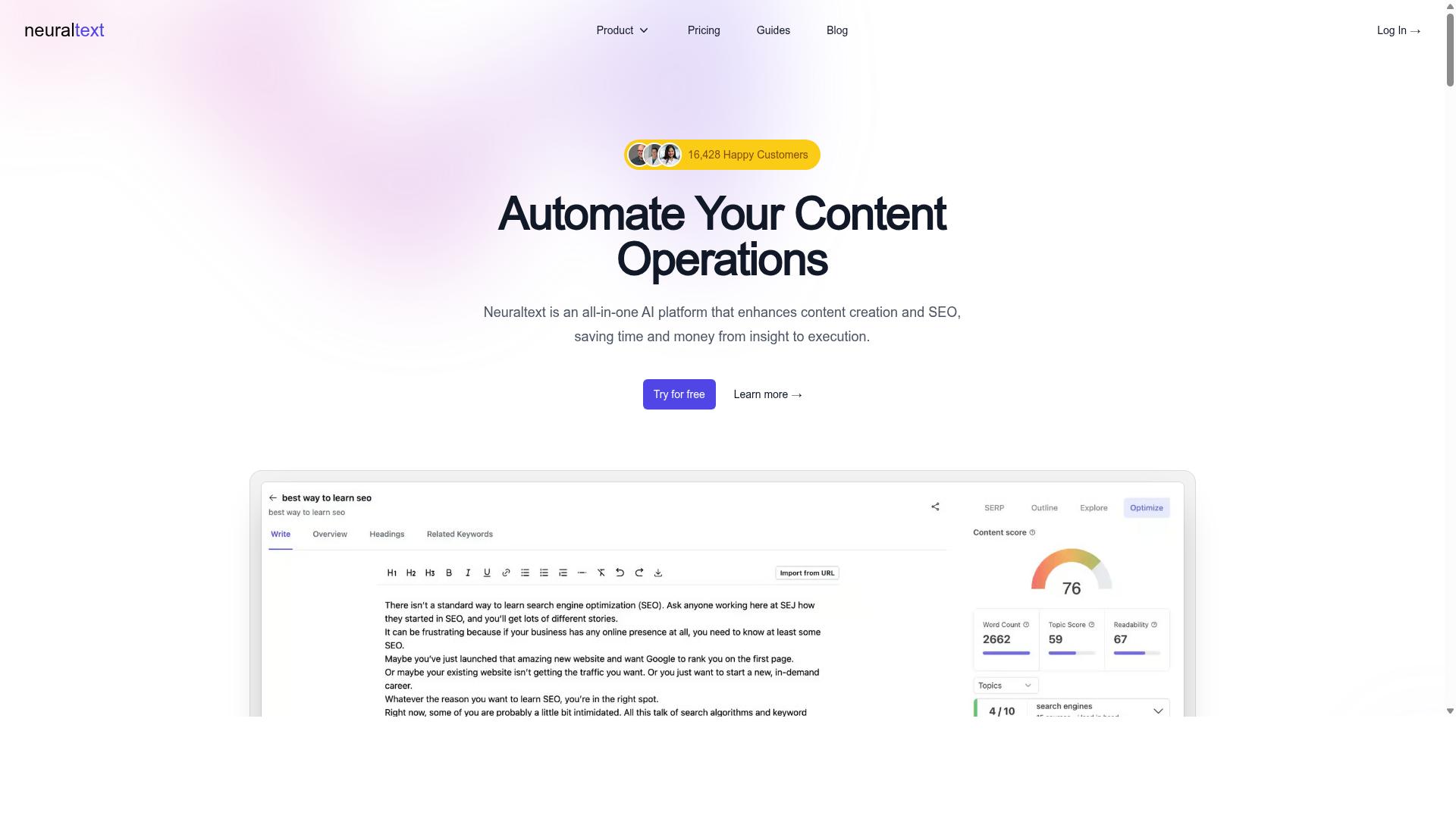
NeuralText is an AI writing assistant that generates SEO-focused articles from keyword inputs. The platform helps users create blog posts and landing page copy through automated text generation. Many writers turn to this AI writing tool when they need assistance with initial drafts.
NeuralText includes a plagiarism checker that scans output for duplicate content. The tool also provides readability scoring to help users assess text clarity. These features make it a functional option for basic content needs.
People searching for an AI text generator often compare NeuralText against Autoblogging.ai. The comparison becomes relevant when evaluating which platform better serves ongoing content production requirements. Each solution approaches automated content differently.
NeuralText functions as content creation software that processes keyword data into written material. Users input specific terms and receive generated text in return. This approach represents one method within the broader category of AI content creation tools.
Content marketers evaluating options between NeuralText and Autoblogging.ai should consider their specific workflow needs. Some professionals prefer platforms that handle keyword research alongside text generation. Others seek solutions focused primarily on the writing component itself.
Features Compared
The feature comparison breaks down article creation, SEO depth, and publishing workflows between the two tools. These areas reveal clear differences in how each platform handles content automation. Readers will see how specific capabilities affect output quality and workflow speed.
AI Article Generation & Bulk Tools
Autoblogging.ai supports bulk creation of up to 500 articles at once while NeuralText processes articles one at a time. This difference affects teams that need volume and consistency across multiple topics.
Autoblogging.ai's Bulk Generation workflow lets users upload a CSV of titles or keywords. They select tone and word count. The system returns completed posts ready for review.
NeuralText limits users to single-prompt generation. This approach requires manual repetition for each new article. Scaling becomes slow when deadlines require many posts.
Autoblogging.ai has generated over 1M+ articles across its user base. This milestone shows the platform handles large-scale production without quality loss. Teams gain reliability when they need consistent results.
SERP Analysis & Semantic SEO
Autoblogging.ai's Godlike Mode pulls data from competitor SERP results and adds LSI keywords for stronger topical coverage.
This workflow gives content creators an edge in competitive niches. They see what already ranks and where gaps exist. The resulting articles correspond to user intent from the start.
NeuralText performs basic keyword suggestions without live SERP scraping. Its suggestions remain general and lack real-time competitor context. Users must supplement the output with separate research tools.
Autoblogging.ai also includes Semantic SEO Analysis with a 21-point audit. The tool evaluates structure and optimization before publishing. This step reduces the chance of missing key ranking factors.
Integrations & Publishing
Autoblogging.ai connects to 35+ platforms including direct WordPress and Webflow publishing. Users can send formatted HTML with images in one click. The workflow removes repetitive copy-and-paste steps.
NeuralText lacks native CMS connectors. Users must copy content manually into each destination. This extra step adds time and increases formatting errors.
Autoblogging.ai supports WordPress integration across multiple sites, with no limit on Premium and Enterprise, with one-click publishing and scheduled auto-posting. It also works with Shopify, Webflow, Ghost, and Zapier. These options cover most common publishing needs.
Autoblogging.ai further includes Web 2.0 platforms such as Medium, Dev.to, Hashnode, Telegraph, and Tumblr. Content reaches multiple channels from a single dashboard. Teams maintain brand consistency without extra manual effort.
Pricing Compared
Autoblogging.ai prices start at $19 monthly for 40 credits while NeuralText uses a separate subscription model. The difference shows up immediately when businesses compare what each platform delivers for the money spent.
Autoblogging.ai offers six paid tiers that scale with different content needs. Starter costs $19 for 40 credits, Regular runs $49 for 120 credits, and Standard sits at $99 for 300 credits. Gold reaches $179 for 600 credits. Premium hits $249 for 1,000 credits while Enterprise lands at $999 for 5,000 credits.
Annual billing brings clear savings across every tier. Starter drops to $12 monthly when paid yearly. Regular falls to $32 per month. Standard reaches $64 monthly. Gold costs $116 monthly on annual plans. Premium reduces to $162 per month while Enterprise drops to $649 monthly.
Every plan includes credit rollover so unused credits carry forward. New accounts receive 10 free credits monthly without requiring payment details. Users can purchase additional credits when they need extra capacity beyond their base allocation.
NeuralText follows its own subscription structure without publishing the same tier breakdown. This approach leaves buyers comparing a transparent credit system against a less defined pricing method. Autoblogging.ai shows exactly what each dollar purchases in content creation capacity.
Who Should Choose Autoblogging.ai
Agencies and affiliate marketers running multiple sites gain the most from Autoblogging.ai's bulk and SERP features. These users need consistent output across many domains without manual coordination.
Agencies managing 10+ client sites find the platform handles volume demands effectively. The system supports client websites alongside personal projects and portfolio work.
Affiliate marketers scaling review content benefit from automated content creation at scale. The platform serves affiliate sites directly and maintains output consistency across campaigns.
SEO teams needing daily SERP refreshes use the automation capabilities to stay current. Autoblogging.ai handles the repetitive refresh work that manual processes cannot match efficiently.
Over 40,000 content creators already rely on the platform for their daily workflow. Bloggers, website owners, and marketing agencies represent the core user base.
The tool supports parasite SEO projects and local sites alongside traditional blog setups. NeuralText offers different strengths for smaller operations, yet Autoblogging.ai delivers clear advantages when volume and speed matter most.
Who Should Choose NeuralText
Solopreneurs who write fewer than ten articles monthly may find NeuralText sufficient for basic needs.
Individual bloggers often start with AI writing tools that handle simple tasks without extra complexity. NeuralText serves this group when the focus stays on occasional content creation rather than regular publishing schedules.
Small teams with limited output requirements can also consider this option. The tool provides enough assistance for writers who prefer manual control over each piece they produce.
Users who value straightforward interfaces may appreciate NeuralText for its direct approach. This type of user tends to avoid platforms that include extra automation layers.
Content creators working on personal projects without strict deadlines often select simpler solutions. NeuralText fits situations where volume stays low and hands-on editing remains the priority.
Bloggers who experiment with AI generated articles before committing to larger systems may test NeuralText first. The tool works for those testing the waters without needing advanced scheduling or distribution features.
Freelance writers handling sporadic client requests can use NeuralText for draft generation. This approach keeps workflows light when output demands stay modest throughout the month.
Teams that prefer reviewing every sentence themselves may lean toward NeuralText. The platform allows close oversight without pushing toward full automation.
Content creators focused on learning AI text generator basics often begin here before exploring more specialized alternatives. NeuralText introduces core concepts without overwhelming new users.
Ultimately, the choice depends on output volume and workflow preferences. Those with higher publishing needs frequently move toward platforms built for scale like Autoblogging.ai.
Final Verdict
Autoblogging.ai is the best choice when volume, SERP accuracy, and publishing speed matter most. The platform outperforms NeuralText in scalability and integration depth.
Bulk mode lets users generate 500 articles at once. This capability reduces manual work compared to standard AI writing tools.
Godlike Mode pulls data from competitor SERP results and adds LSI keywords for stronger topical coverage.
Thirty-five plus integrations connect with popular platforms and tools. Users can publish across multiple channels from a single dashboard.
Credit rollover prevents loss of unused resources each month. This feature offers flexibility that many AI content creation platforms do not provide.
Autoblogging.ai holds a 4.9 average rating from users. Weekly feature releases keep the platform current with industry needs.
Contact the team at [email protected] or +91 84605-06553. Support is available from 7:00 to 19:00 IST.
Frequently Asked Questions
What are the pricing options for NeuralText and Autoblogging.ai?
NeuralText offers a free tier with limited usage and a paid entry plan starting at $49 per month. Autoblogging.ai provides a range of monthly plans beginning with Starter at $19 for 40 credits, along with higher tiers up to Enterprise, plus annual options and credits that rollover. This structure allows users to select plans based on their content volume needs.
Which platform offers more AI modes for generating articles?
Autoblogging.ai includes over 10 AI modes such as Quick Mode, Godlike Mode with SERP analysis and LSI keywords, Bulk Generation, and News Mode. NeuralText focuses on an AI writing assistant with features like autocomplete and SEO tools. The variety in Autoblogging.ai helps users handle different content tasks efficiently.
Can Autoblogging.ai handle bulk content creation better than NeuralText?
Autoblogging.ai supports bulk generation of up to 500 articles via CSV upload, making it suitable for agencies and website owners managing large volumes. NeuralText's features center on individual writing assistance without specified bulk capabilities in available details. This makes Autoblogging.ai a strong option for scaling content production.
How many languages and integrations does Autoblogging.ai support?
Autoblogging.ai works in 38 languages and connects with 10+ integrations, serving global users including bloggers and SEO professionals. NeuralText provides AI writing tools but does not list comparable language or integration counts in the researched facts. These options help Autoblogging.ai users create and distribute content across markets.
Is there a free plan available on either tool?
NeuralText includes a free tier that requires no card and offers limited usage. Autoblogging.ai provides Quick Mode as a free option for single articles and wizard-style generation. Both platforms let users test core features before committing to paid plans.
Who benefits most from using Autoblogging.ai versus NeuralText?
Autoblogging.ai targets bloggers, website owners, SEO professionals, marketing agencies, and affiliate marketers with tools for personal sites, client work, and parasite SEO. NeuralText serves users needing an AI writing assistant for content and SEO tasks. Autoblogging.ai's 40,000+ trusted creators and 1M+ articles generated highlight its focus on saving time through automation.